
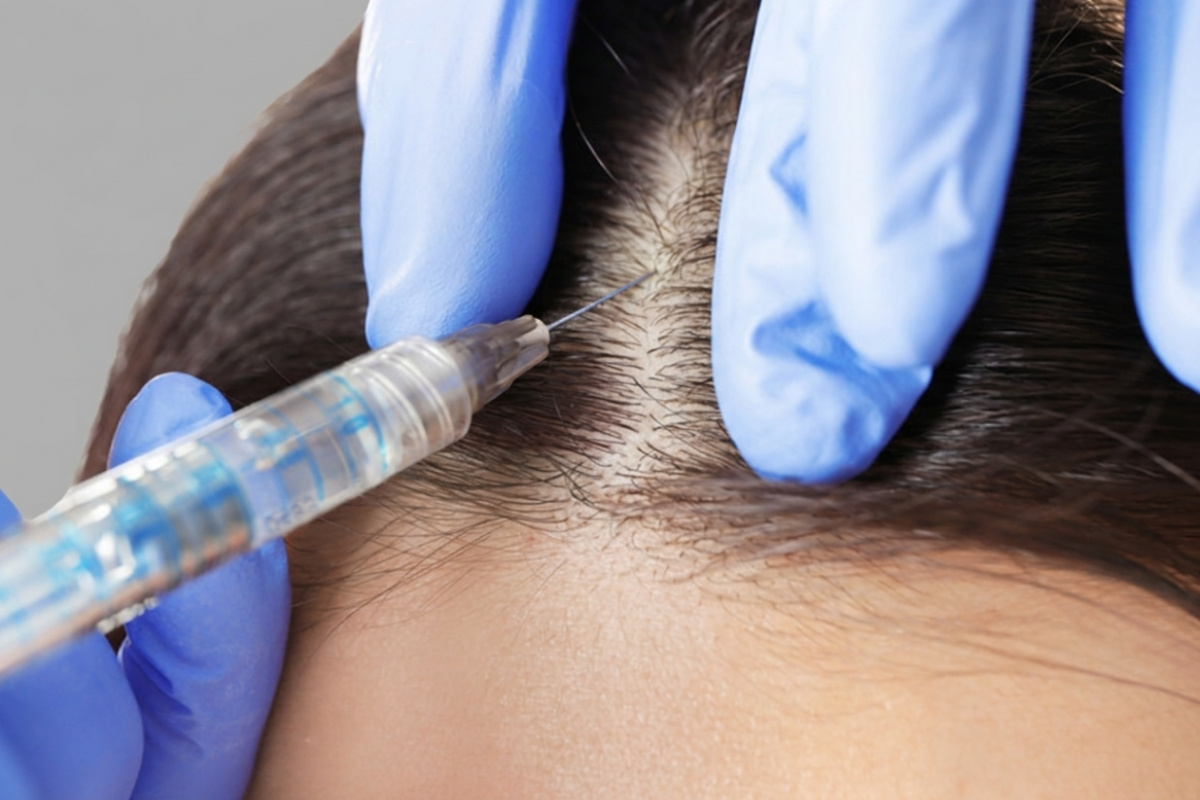
Hair thinning and baldness can develop gradually due to factors such as genetics, hormonal changes, ageing, lifestyle, or underlying scalp conditions. Early evaluation can help identify the cause and guide a personalized approach to managing hair loss and supporting healthier hair growth.
Hair thinning is different from excessive hair fall. While telogen effluvium is mainly characterized by increased shedding, hair thinning occurs when the scalp gradually loses hair density and/or individual hairs become finer.
The most common cause is androgenetic alopecia (pattern hair loss), which can affect both men and women. Other causes of progressive thinning include nutritional deficiencies, hormonal disturbances, scalp disorders, chronic telogen effluvium and certain medical
conditions. More than one type of hair loss can also coexist.
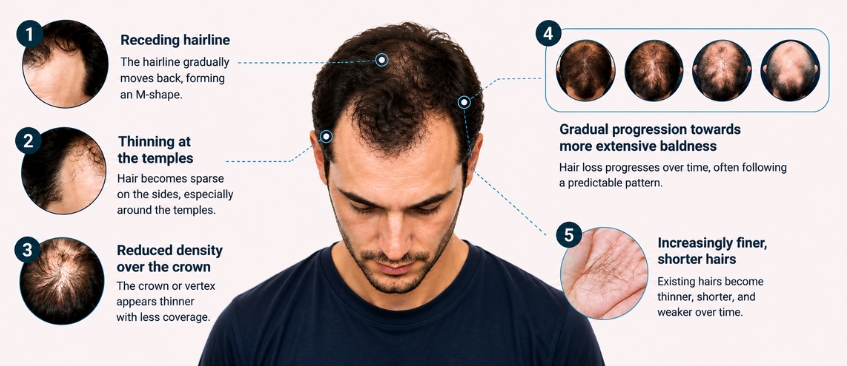
Receding Hairline * Thinning at the Temples * Reduced Density Over the Crown * Gradual Progression Towards Baldness * Increasingly Finer, Shorter Hair
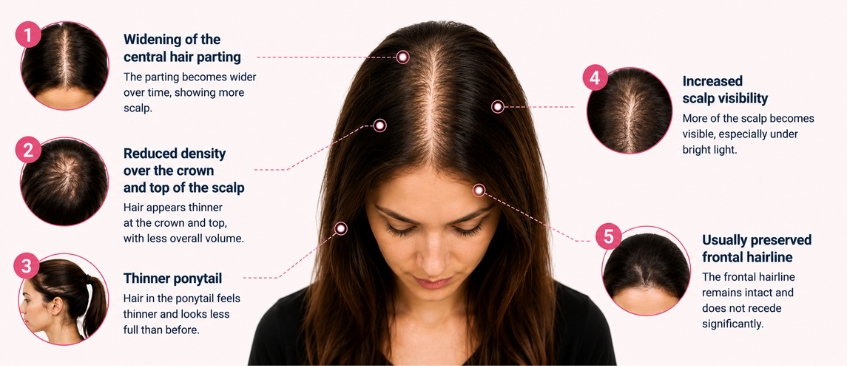
Widening of the Centre Hair Parting * Reduced Density Over the Crown & Top of the Scalp * Thinner Ponytail * Increased Scalp Visibility * Usually preserved frontal hairline
Early diagnosis is important because treatments work best when viable hair follicles are still present. Completely smooth, longstanding bald areas are much less responsive to non-surgical treatments.
A dermatological hair-loss assessment helps determine the pattern, severity, and possible underlying causes of hair thinning or loss. A dermatologist may assess the following:
Pattern and duration of hair loss: Evaluates where the hair loss is occurring and how long it has been progressing.
Family history: Checks for a genetic or hereditary tendency toward hair loss.
Hair density and calibre: Assesses the number and thickness of individual hair strands.
Scalp examination: Examines the scalp for visible changes, abnormalities, or signs of disease.
Dermoscopy/Trichoscopy: Uses magnification to assess the hair shafts, follicles, and scalp in greater detail.
Signs of miniaturisation: Looks for progressively finer hairs, a common feature of pattern hair loss.
Inflammation or scalp disease: Identifies redness, scaling, inflammation, or other scalp conditions that may contribute to hair loss.
Nutritional, hormonal or medical contributors: Considers relevant deficiencies, hormonal changes, medications, or medical conditions that may contribute to hair loss.
The treatment plan depends on whether the patient has pattern hair loss, telogen effluvium, nutritional deficiency, hormonal hair loss or a combination of conditions.
Treatment is individualized according to the stage and type of hair loss. At Eternis Clinic, options may include:
Growth Factor Concentrate (GFC) is an autologous treatment prepared from the patient’s own blood. Growth factors are concentrated and delivered into areas of hair thinning to support the hair follicle environment. GFC may be considered for patients with:
GFC is particularly useful when the goal is to support existing, weakened follicles rather than simply treat the scalp surface. The number and frequency of sessions are decided according to the degree and type of hair loss.
Low-Level Light Therapy (LLLT) is a non-invasive hair restoration treatment that uses low-intensity light, typically delivered through specialized devices, to stimulate and support hair follicle activity. The light is thought to promote cellular activity within the follicles and may help improve the hair growth cycle and support healthier, thicker-looking hair over time.
LLLT may be used as a standalone treatment or as an adjunct to other hair restoration therapies, depending on the underlying cause and extent of hair loss. It is generally considered more suitable for patients with early to moderate hair thinning, where viable hair follicles are still present. Regular sessions may be recommended to maintain and support the treatment response.
Scalp threads are a minimally invasive hair restoration procedure in which specialized threads are placed in selected areas of the scalp to support the local scalp environment. The procedure is intended to provide targeted stimulation around the treatment area and may help support the conditions needed for healthier follicular activity.
Scalp threads may be considered as an adjunctive treatment for appropriately selected patients with hair thinning, particularly when the goal is to support scalp and follicular health alongside other hair restoration approaches. Suitability depends on the underlying cause, pattern, and extent of hair loss and should be determined following a dermatological assessment.
Autologous Micrograft Progenitor Cell Therapy is a regenerative hair restoration approach that uses a small sample of the patient’s own hair-bearing follicles. The collected tissue is carefully processed to obtain a cell-rich micrograft preparation, which is then introduced into selected areas of the scalp affected by hair thinning.
The therapy is designed to support the local follicular environment and regenerative processes that contribute to hair growth. It may be considered for appropriately selected patients with more significant hair thinning or when a regenerative approach is suitable. Treatment suitability depends on the individual’s pattern and cause of hair loss and is determined following a detailed dermatological assessment.
In androgenetic alopecia (pattern hair loss), DHT can contribute to the gradual miniaturisation of genetically susceptible hair follicles, resulting in progressively finer hairs and reduced hair density. Reducing the effect of androgens on susceptible follicles may therefore form part of a dermatologist-guided treatment approach.
At Eternis Clinic, DHT-blocking mesotherapy may be considered for selected patients after evaluating the pattern and severity of hair loss, underlying diagnosis, medical history, and individual treatment requirements. Mesotherapy involves delivering a selected formulation through small intradermal injections into the scalp, with the aim of providing targeted treatment to the affected areas. Evidence for injectable treatments is promising but remains variable, with differences in formulations, techniques, and treatment protocols.
Men — Dutasteride Mesotherapy
Dutasteride is a 5-alpha-reductase inhibitor that reduces the conversion of testosterone into DHT. Dutasteride-based mesotherapy may be considered for selected men with androgenetic alopecia as a localized treatment approach, particularly where reducing DHT activity is an important part of the treatment strategy.
Women — Bicalutamide Mesotherapy
For selected women with androgen-related hair loss, bicalutamide-based mesotherapy may be considered following appropriate clinical evaluation. Bicalutamide works by blocking androgen receptors, although evidence for its use through mesotherapy remains limited and the treatment is considered on an individual basis.
The suitability of anti-androgen treatment depends on factors including sex, age, pattern and cause of hair loss, medical history, current medications, and reproductive considerations. A detailed dermatological assessment is therefore important before selecting an anti-androgen or injectable treatment approach.
The therapy is designed to support the local follicular environment and regenerative processes that contribute to hair growth. It may be considered for appropriately selected patients with more significant hair thinning or when a regenerative approach is suitable. Treatment suitability depends on the individual’s pattern and cause of hair loss and is determined following a detailed dermatological assessment.
Hair mesotherapy is a minimally invasive treatment that involves delivering selected formulations into the scalp through a series of small intradermal injections. Depending on the underlying cause of hair loss and the individual’s treatment needs, different formulations may be selected to support the scalp and follicular environment.
The localized delivery of selected ingredients is intended to provide targeted support to areas affected by hair thinning. Hair mesotherapy may be considered as an adjunct to other hair restoration treatments, rather than as a replacement for treatments addressing the underlying cause of hair loss.
The formulation, injection technique, treatment frequency, and number of sessions are determined based on the patient’s diagnosis, degree of hair loss, scalp condition, and overall treatment plan. As mesotherapy protocols and evidence continue to evolve, treatment should be performed following a thorough dermatological assessment and under appropriate medical supervision.
Hair loss can involve more than one underlying factor, which is why treatment may need to address different aspects of follicular and scalp health. At Eternis, the treatment plan is tailored to the individual after assessing the type, stage, pattern, and progression of hair loss.
Depending on the clinical findings, a combination approach may include:
The objective is to create a comprehensive, individualized hair restoration plan that focuses on maintaining existing follicles, supporting hair calibre and density, and managing the progression of hair loss over the long term. Combination approaches have been studied in androgenetic alopecia, although the choice and effectiveness of individual treatments can vary considerably between patients.
At Eternis Clinic, hair loss is approached as a medical condition rather than simply a cosmetic concern. The type, pattern, severity, and stage of hair loss are assessed before determining the most appropriate course of treatment.
Based on the individual diagnosis and treatment needs, our dermatologists may recommend a single treatment or a combination of therapies, with the approach tailored to the patient rather than following a one-size-fits-all protocol.
The objective goes beyond simply reducing hair fall. Treatment focuses on preserving existing follicles, supporting healthier hair growth, improving hair calibre and density, and managing the progression of hair loss for the best possible long-term outcome.
Hair thinning is a gradual reduction in hair density or the thickness of individual hair strands. It can occur due to genetics, hormonal changes, ageing, nutritional deficiencies, stress, or scalp conditions.
Hair loss refers to excessive shedding or loss of hair from the scalp, while hair thinning refers to a gradual reduction in hair density or the diameter of individual hair strands. Hair thinning can occur as a result of progressive follicle miniaturisation, whereas hair loss may be temporary or progressive depending on its underlying cause.
There is no single best treatment for every type of hair loss. At Eternis Clinic in Pune, treatment is selected after identifying the underlying cause and extent of hair loss, with options tailored to each patient’s condition.
Hair-loss treatments are generally considered safe when chosen according to the individual’s condition and administered by a qualified dermatologist. Since treatment options differ in their suitability and possible side effects, a thorough evaluation of the hair loss and relevant medical history should be completed before treatment begins.
Copyright © Eternis Skin Clinic 2026 All Rights Reserved.
Eternis Skin Clinic
We're Online!
Eternis Skin Clinic
How can we help you today?
Powered by Elementor